Information spread across working sheets
Audit information could sit across manual or disconnected working sheets, so no single record held the audit as it currently stood.
Case study 06
Turning a fragmented audit process into a structured workflow with report-ready outputs.
A pharmacy audit involves more than checking quantities. Findings need to be captured consistently, variances need to stay traceable, and the final audit record needs to be assembled accurately. I redesigned that process around a connected digital workflow, so information is recorded as the audit happens — reducing the manual consolidation normally required after it ends.
Workflow DesignAudit OperationsReconciliationReporting
The problem was not the absence of software. The audit itself was being done carefully — what did not work was everything the audit left behind it.
Audit information could sit across manual or disconnected working sheets, so no single record held the audit as it currently stood.
System quantities and physical counts lived in different places and had to be brought together by hand before a variance could even be described.
Findings recorded while the audit was running had to be gathered and reassembled once it was over, from records that were never designed to be joined.
Items needing a recount or an investigation were tracked outside the main record, which made their current status harder to see.
Preparing the final audit report was administrative effort layered on top of the audit itself, rather than something the audit had already produced.
While the audit was in progress, what had been checked and what remained were not visible in one place to everyone who needed to know.
An audit already costs the team hours of careful physical work. What follows it should not quietly cost as much again.
The report should be an output of the audit process — not a second process that begins when the audit finishes.
Reconstructing the audit afterwards spends the team a second time — on administration rather than on the findings the audit exists to surface.
The longer the gap between counting and reporting, the longer management waits for a position it can actually act on.
Every re-entry between a working sheet and a report is another opportunity for the two to disagree, and another figure someone has to reconcile.
A variance recorded on a separate sheet is easy to lose sight of until somebody goes looking for it.
A finding is only useful if you can see which item it belongs to, when it was recorded and what has happened to it since.
When the record is fragmented, it is unclear who is holding an open item and what that item is waiting on.
Items needing a recount or an investigation have to stay visible after the audit closes, rather than disappearing into it.
An audit exists to demonstrate control. A process that cannot show its own working weakens the assurance it is meant to provide.
I worked across the operational analysis, workflow design and implementation. What follows is what I personally did.
Examined how the audit was actually being performed rather than how it was described, and identified where the same information was being written down, carried across or reassembled more than once.
Mapped the sequence end to end — from checking an item, through identifying a variance, to follow-up and the final audit record — including the exception paths that only appear when something does not match.
Defined what information each stage of the audit needs to capture, so the record builds correctly as work is done instead of being interpreted afterwards.
Designed the workflow linking the physical audit activity to the digital audit record, so that recording is part of doing the audit rather than a task that follows it.
Connected system quantity, physical quantity, variance, finding and follow-up status within one workflow, so every audited item carries its own state rather than being described in several places.
Developed the practical digital workflow supporting the redesigned process — built to be usable while an audit is actually running, not only in a demonstration.
Checked the workflow and its outputs against how an audit genuinely has to be worked, and adjusted the design where the process and the tool disagreed.
Translated the redesigned process into something operationally usable, rather than leaving it as a written recommendation for somebody else to build.
The redesign was not about replacing a sheet with a screen. It was about removing the second process that used to begin when the audit ended.
Audit and reporting as two sequential processes
The two marked stages are the work the audit created for itself: they exist only because the record was assembled after the fact rather than during.
Audit and record built together
Each step writes to the same record, so the audit and the reporting information advance together instead of one waiting on the other.
The exception path runs alongside the audit rather than blocking it. An item needing confirmation stays open and visible, and the overall audit record still completes. Nothing here resolves a variance automatically — confirmation remains a human step.
Described as operations rather than as features. Each stage exists because the audit needs it, not because software could do it.
Create and prepare the audit, and establish the working scope it will cover.
Record and compare the relevant system and physical quantities for an item, at the point the item is checked.
Surface the differences that need attention, as they arise rather than at the end.
Keep observations and audit findings attached to the record they belong to, so a finding never becomes a loose note.
Maintain one structured view of what has been checked and what remains, available while the audit is still running.
Use the information already captured during the audit to produce the audit record, instead of rebuilding it from separate sheets.
Keep items awaiting a recheck, recount or investigation visible for subsequent confirmation.
Audit completed. Report ready.
In a standard audit, the report can be complete by the end of the audit, because the information reporting needs is captured and structured during the audit itself.
Instead of starting a separate consolidation exercise afterwards, the team can move directly to reviewing findings and acting on exceptions.
That saves staff time. The work normally spent consolidating audit information once the audit is over — gathering findings, reconciling sheets, rebuilding the report — is reduced, because the reporting information is captured and structured as the audit progresses.
Items requiring variance rechecking, recounting or investigation remain visible for follow-up and may require subsequent confirmation. A standard audit completing does not mean every variance is closed.
The time saving is stated qualitatively because it has not been measured. No percentage, hours figure or productivity number is claimed here, and none should be added without evidence.
The audit report is not assembled once the audit is over — it is generated from the record the audit has been building. What follows is that output, taken from the implemented system.
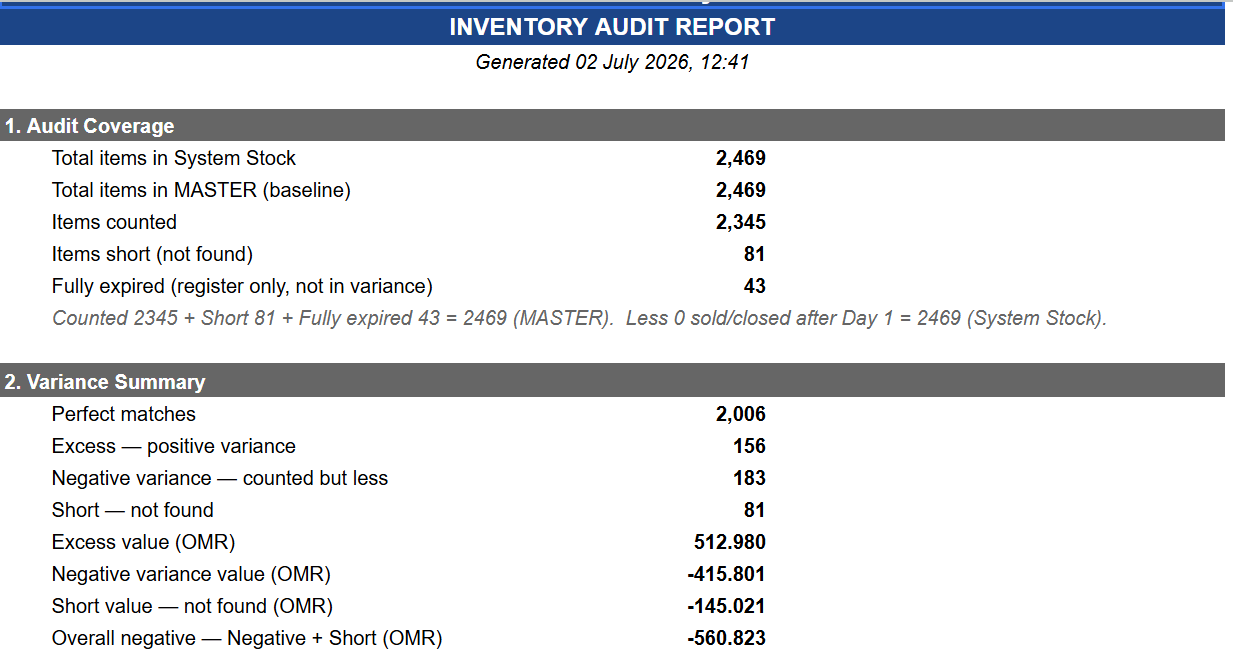
The report above is produced by the implemented workflow. The diagram below explains the per-item record behind it — an editorial illustration of the field structure, not a system screen.
The same audit, described twice.
BeforeDisconnected or manual working sheets
AfterOne structured audit workflow
BeforeManual consolidation after the audit
AfterReport data built during the audit
BeforeFindings spread across working records
AfterFindings connected to the audit record
BeforeVariance follow-up harder to track
AfterExceptions remain identifiable for follow-up
BeforeReporting treated as a separate activity
AfterReporting becomes an output of the audit process
What changed is where the work sits, and what exists at the moment the audit ends.
The redesigned workflow reduced the need for post-audit manual consolidation, and with it the administrative work and staff time that consolidation consumed. Because each item is recorded once, at the point it is checked, the audit record becomes progressively complete as the work is performed rather than being assembled from separate sheets afterwards.
Identified variances are visible as they arise instead of surfacing during a later review, and findings stay attached to the item they describe. Follow-up remains inside the same structured process rather than moving to a parallel list, so an item awaiting a recount is still part of the audit record rather than an exception to it.
For a standard audit, this means the report can be completed by the end of the audit. It also means normal audit completion is separated from the individual exceptions: closing the audit and closing every variance are no longer the same event, and neither one waits on the other.
The chain runs the whole way through: audit execution, structured capture, reconciliation, audit report, and then the reconciled list of adjustments the system requires. Each stage is built from the one before it rather than reassembled from working sheets, which is where the post-audit consolidation work used to sit.
The workflow does not stop at the report. Confirmed variances are reconciled into the list of adjustments the system requires, so the audit ends with the next operational step already specified.
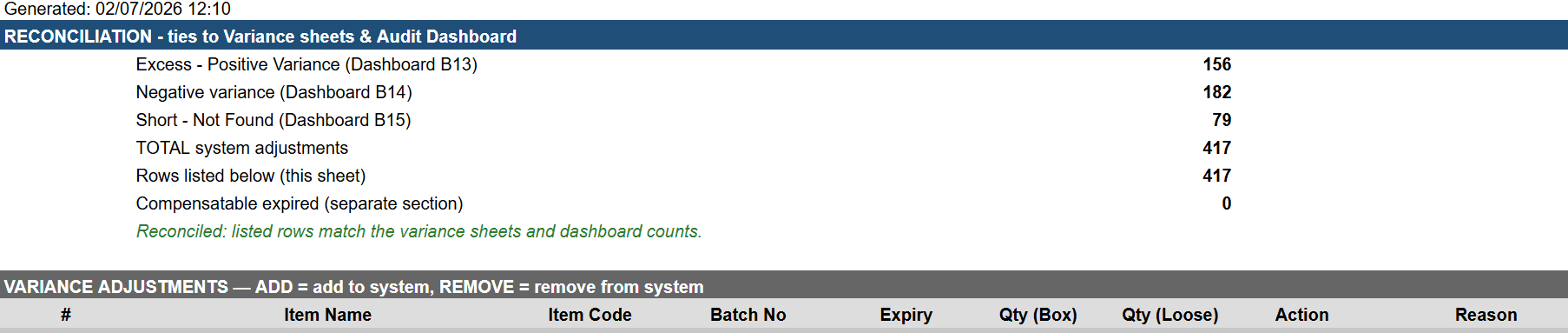
Confirming a variance remains a human step. What the workflow removes is the manual assembly of the list, not the judgement behind each line on it.
The reduction described here is qualitative. No measured figure is published, because none has been measured. What transfers to another operation is the change in the structure of the process and in what exists when the audit ends.
This was not primarily a form-design problem. It was a workflow problem.
A digital form can only capture what someone decides to type into it. The work that mattered here was understanding how the audit actually operates on the floor, finding the points where information and effort came apart, and redesigning the sequence so that doing the audit and recording it became the same act.
Structuring the information was the middle of the job. It was bracketed by operational understanding at one end — what an audit genuinely has to capture, and where the exceptions live — and by a working tool at the other, one usable during an audit rather than described in a document.
Problem Process Data Solution Implementation
The same route as every other piece of work here, applied to a process rather than to a dataset. Understanding the operation decided what the workflow had to do; structuring the information decided what it had to hold; building it decided whether any of that survived contact with a real audit.
This case study describes a process and a workflow, not an organisation. No pharmacy, customer, supplier or individual is identified. The two reports shown are real outputs of the implemented workflow, published with identifying information removed; item-level rows — product names, item codes, batch numbers and expiry dates — are withheld from the adjustment list. The audit-record illustration is an editorial diagram of field structure, not a system screenshot.
Contact
If your team finishes an audit and then starts rebuilding it from working sheets, describe how the process runs now. I'll tell you where I'd look first.