Case study 01

IMTISUITE

Connected Pharmacy Operations Platform

Pharmacy operations rarely fail because the information does not exist. The harder problem is that sales, inventory, purchasing, compliance and management activity tend to sit in separate workflows, separate reports and separate responsibilities. IMTISUITE was designed around a different premise: connect those operational domains into one platform, while giving each user the workflows that belong to their role.

Product StrategyHealthcare OperationsWorkflow ArchitecturePlatform Design

01
Pharmacy Portal
02
Distributor Operations
03
Regulatory Portal
One connected platform
three operating contexts, one platform underneath
Role
Product direction, operational analysis, platform architecture and implementation.
Product
A connected pharmacy operations platform spanning operational, commercial and governance workflows.
Operating contexts
Three role-appropriate portals — pharmacy, distributor operations and regulatory — over one connected platform.
Status
Implemented product components and tested workflows, with the architecture and the product continuing to develop.

The problem

At platform level

The problem IMTISUITE addresses is not a missing feature. It is that the decisions a pharmacy makes every day depend on each other, and the tools that support them usually do not.

Decisions that depend on each other, held apart

What sells changes what should be held. What is held changes what should be bought. What is bought changes supplier position and cost. Each of those is well understood on its own; the dependency between them is where the judgement actually sits, and it is the part no single tool tends to hold.

Visibility bought at the price of navigation

Teams can usually get to the information eventually. Getting to it means moving between places, reconciling what each one says, and forming the connected picture in their heads rather than reading it.

Commercial and compliance treated as separate worlds

Compliance activity and commercial activity operate on the same stock, the same suppliers and the same business, yet they are commonly supported by unrelated systems — as though controlled medicines and margin belonged to different operations.

Different roles, different responsibilities

A pharmacist, a distribution operator, a manager and a regulatory user need different views and different actions. Giving all of them the same screen serves none of them well.

Management given another report instead of a picture

Adding an isolated report to an already fragmented estate produces one more thing to reconcile. What management needs is connected visibility, not additional output.

Traceability as a requirement, not a feature

Healthcare workflows carry obligations about who did what, to which stock, and on what authority. That has to be part of how the system is structured rather than something added on later.

One site is not the shape of the problem

Growth from a single pharmacy to several branches, or to several organisations, is not more of the same work. A structure built for one implementation has to be rebuilt for every new one.

Why it mattered

Five dimensions

The case for connecting these domains is not elegance. It is that every one of them is already making decisions with incomplete sight of the others.

Connecting a platform does not mean showing every user everything. It means the information is related — and the access is not.

Operational control

Sales, stock, purchasing and workflow information should connect rather than each be interpreted in isolation and reconciled afterwards by whoever happens to be looking.

Commercial visibility

Inventory, purchasing, pricing, suppliers and customers all contribute to commercial performance. Seen separately, each looks defensible while the combined position drifts.

Governance

Compliance and regulatory activity need clear ownership and traceability — which means being structured into the platform rather than tracked beside it.

Role clarity

Different users need appropriate access to different operational responsibilities. Access design is part of the product, not an administrative afterthought.

Scalability

A product architecture should support expansion without the system being rebuilt separately for every site it reaches.

My role

I defined the product direction from the operational problems outward: analysing pharmacy workflows, identifying the shared data and decision points, structuring the platform around role-specific responsibilities, designing the product experience, and progressively building and validating the implementation.

The product direction, the architecture and the implementation are mine. This is not a case study about a team.

Defined

Set the product direction — what IMTISUITE is for, which operational problems it exists to address, and, just as importantly, what it is not trying to be.

Analysed

Worked through how pharmacy and distribution operations actually run day to day, from years inside them, rather than from a specification of how they are supposed to run.

Structured

Identified the information and decision points the domains genuinely share, and separated them from the ones that only look shared — which is what determines where a platform can be connected and where it must not be.

Designed

Designed the platform architecture and the role contexts: what each portal is responsible for, what it can see, and how the workflows behind them relate.

Prioritised

Decided what to build first and what to leave — a product of this scope fails by attempting everything at once far more often than by attempting too little.

Built

Built the implementation: the working product components and the workflows behind them, rather than a specification for somebody else to build.

Validated

Tested the product against real operational scenarios and against how the work is genuinely done, and changed the design where the two disagreed.

Evolved

Refined the product through implementation — workflow, terminology, access design and structure all moved as building revealed what the earlier thinking had missed.

Three operating contexts

One platform underneath

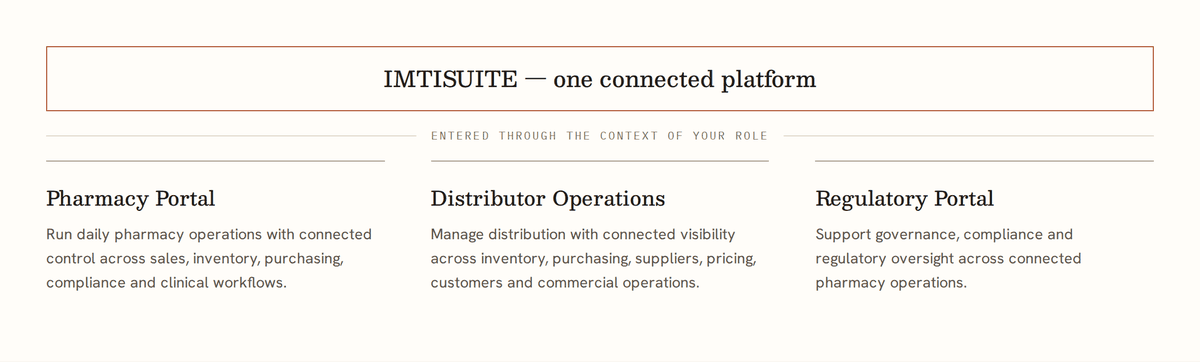
IMTISUITE is organised as three operating contexts over one connected platform. They are not three products that happen to share a name.

platform structure · one platform → three operating contexts explanatory diagram

IMTISUITE — one connected platform

Pharmacy Portal

Run daily pharmacy operations with connected control across sales, inventory, purchasing, compliance and clinical workflows.

Distributor Operations

Manage distribution with connected visibility across inventory, purchasing, suppliers, pricing, customers and commercial operations.

Regulatory Portal

Support governance, compliance and regulatory oversight across connected pharmacy operations.

shared beneath all three
  • connected operational data
  • shared workflow services
  • role-appropriate access

The portals are entry points into different responsibilities, not separate systems. What differs between them is the work each is accountable for — not whether the underlying operation is the same one.

Platform structure — simplified representation of the product architecture. Structure only; this is an editorial diagram rather than a depiction of the software.

Connected, but not identical

Connected data and workflows, plus role-appropriate access, is what makes operational control usable.

A platform that connects everything and then shows everyone all of it has not solved the fragmentation problem — it has relocated it into a single screen.

Related information, separated responsibility

A pharmacist, a distribution operator, a manager and a regulatory user may all work on activity that touches the same stock. That does not mean they should hold the same responsibilities or see the same surface.

The portal is the responsibility, not the menu

Each context is defined by what that role is accountable for. It follows that the workflows, not just the navigation, differ between them.

Access is a product decision

What a role can see and do shapes how the product is used and how much of it can be trusted. It is designed alongside the workflows rather than configured afterwards.

Connection is what makes separation safe

Because the domains are connected underneath, narrowing a role’s view does not cut it off from the consequences of other people’s work — it just stops that work being that person’s to do.

From modules to connected operations

Dependencies, not a module list

The architecture follows the dependencies rather than the org chart. These are the relationships the product is built to hold.

connected operations · the dependencies the platform holds explanatory diagram

Core operating loop

Sales Inventory Purchasing Suppliers

Connected outward to

Customers & pricing

Who buys, on what terms, at what price.

Compliance

Obligations attaching to stock and medicine activity.

Regulatory workflows

Governance, compliance and regulatory oversight.

Management visibility

The connected picture across all of it.

A sales pattern changes what inventory should be holding.

An inventory position changes what purchasing should be buying.

Purchasing changes supplier activity, terms and cost.

Stock and medicine activity can carry compliance implications.

Management needs sight of the relationships, not just the parts.

This is not an attempt to list every module. It is the set of dependencies that made a connected platform the right answer rather than a suite of separate tools.

Simplified representation of the operational relationships the architecture is designed around. Relationships only — not a module inventory and not a depiction of the software.

Evidence

Implemented product

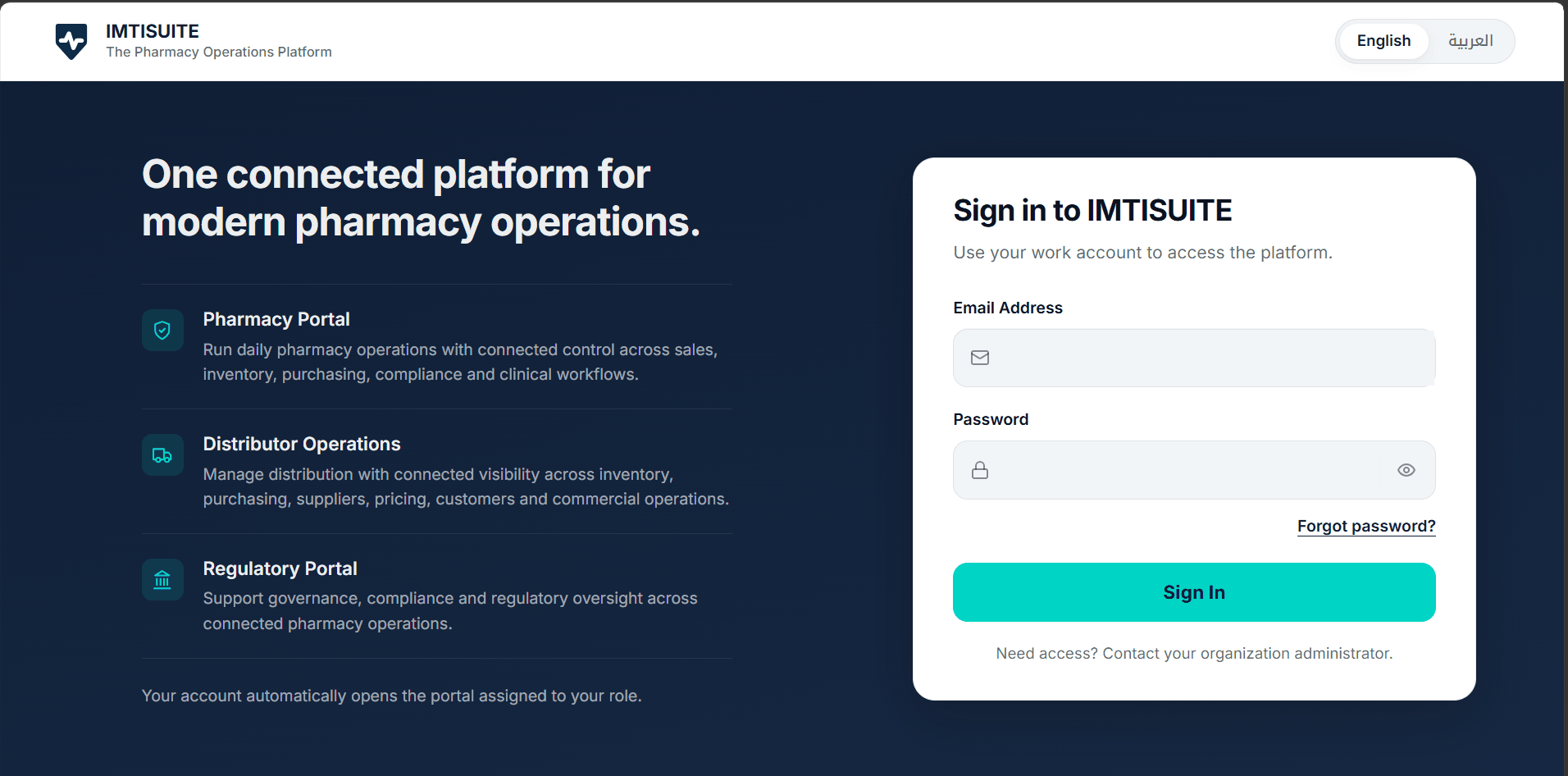
The three operating contexts are not three products that share a name. They are one platform, entered through the responsibility a person holds.

evidence · platform entry — role-directed operating contexts implemented product
IMTISUITE sign-in screen: one connected platform for modern pharmacy operations, describing the Pharmacy Portal, Distributor Operations and Regulatory Portal beside a work-account sign-in form, closing with the note that an account opens the portal assigned to that role.
Implemented IMTISUITE platform entry. Account details removed; the interface itself is unaltered.

The account decides the context

A user does not choose a portal from a menu of products. The operating context follows from who they are, which is the access model made visible at the first screen.

Three contexts, one entry

Pharmacy, distributor operations and regulatory are presented together because they belong to one platform — the distinction between them is responsibility, not installation.

behind the entry · one platform → three operating contexts explanatory diagram
IMTISUITE platform structure: one connected platform resolving into the Pharmacy Portal, Distributor Operations and Regulatory Portal.
Simplified representation of the IMTISUITE product architecture — structure only, not a depiction of the software.

Start with the operation

The product route

That is the sentence on the front of this site, and IMTISUITE is the largest thing it has had to survive.

I do not start with technology. I start with the operational problem.

Operational problem

What actually goes wrong, in the operation, on a normal day.

Map the workflow

How the work moves, including the exceptions.

Roles & decisions

Who is accountable for what, and where judgement sits.

Shared information

What the domains genuinely have in common.

Product structure

The architecture that follows from all of the above.

Implement

Build it, so the thinking meets reality.

Validate & iterate

Check it against the operation; change what was wrong.

A product built the other way round — technology first, operation fitted to it afterwards — produces software that is defensible in a demonstration and awkward on a Tuesday morning.

Building for scale, then refining through implementation

Architecture → what building taught

A pharmacy screen and a pharmacy platform are different commitments. The second one has to hold up when there is more than one of everything — and most of what taught me that came from building it rather than from planning it.

Structured for more than one of everything

Organisation and site context

The architecture separates the organisation and site a user is operating within from the workflow logic itself, so the same workflow does not have to be rewritten per location. Designing for more than one site changed decisions in the foundations, which is precisely why it could not be deferred: retrofitting it would have meant unpicking them.

Role-based access held in the platform

Access sits in the platform rather than in each feature, so a new workflow inherits the access model instead of inventing one. That turned out to be an architectural question rather than an administrative one — better answered once in the structure than repeatedly in every feature that came after.

Shared platform services

Capabilities the domains have in common are structured to be shared, which is what stops a connected platform quietly becoming several parallel ones held together by a common login.

Configurable scope

The product direction includes operations enabling the modules relevant to them rather than receiving the entire surface by default.

This describes architecture and product direction. Where a capability is designed for but not yet built, it is described as designed for — not as a feature in production.

Then refined through implementation

The product did not arrive fully formed, and the parts that moved most were rarely the parts that looked hardest at the start.

Understand Build Test Learn Refine

Workflow before interface

Several screens were redesigned not because they looked wrong but because building them exposed a step in the operation that the earlier map had smoothed over.

Terminology is operational, not cosmetic

Where the product’s language drifted from the language the operation actually uses, people hesitated. Naming things as the work names them removed friction that no layout change would have.

Consistency across contexts

The same underlying activity had to behave recognisably in different portals — a constraint on the platform rather than a preference within each one.

Validation through use

The most useful corrections came from running real operational scenarios through the product rather than from reviewing it as a design.

Outcome

Stated precisely

IMTISUITE turned a set of related pharmacy operating problems into a coherent product architecture: one environment connecting operational, commercial and governance workflows while preserving role-specific responsibilities.

Connected operations — related workflows are designed as parts of one operating environment rather than as separate tools that have to be reconciled.

Role clarity — users enter through the context appropriate to their responsibilities, and the access model is part of the architecture.

Domain-led product design — the architecture reflects pharmacy operating realities rather than generic software categories.

Scalable structure — the platform is being designed beyond a single isolated workflow or site.

Working implementation — the product moved past concept into implemented components and tested workflows.

Stated precisely: this is implemented product with tested workflows and a continuing development path. No market adoption, customer numbers, revenue, productivity figure, regulatory certification or completed production rollout is claimed here.

What this demonstrates

This was not primarily a software-interface problem. It was an operating-model problem.

The product challenge was to understand which pharmacy activities belong together, which responsibilities must remain distinct, and how the information between them should connect — and then to translate that operating model into a usable platform.

Everything else in this portfolio is a piece of that question answered at smaller scale: an analysis, a process, a controlled workflow. IMTISUITE is the same reasoning applied to the shape of an operation as a whole.

Operator Analyst Designer Builder

Domain expertise decided what the platform had to understand. Analysis decided what the domains genuinely share. Product judgement decided what to connect and what to keep apart. Building it decided whether any of that survived contact with the operation.

This case study describes a product and its architecture. No customer, organisation, operational record, credential, internal identifier or unreleased commercial information appears. The platform entry is an implemented product view with account details removed; the architecture, domain and method visuals are editorial diagrams of the product structure rather than depictions of software.
Contact

Building something operations will actually use?

If you're shaping a product around how an operation really runs — rather than fitting the operation to the software — describe the problem. I'll tell you how I'd approach it.